
What Is NFPA 20?
NFPA 20 – Standard for the Installation of Stationary Fire Pumps
NFPA 20, developed by the National Fire Protection Association (NFPA), is one of the world’s most widely recognized standards for the installation of stationary fire pumps. It provides comprehensive requirements for the selection, installation, operation, and maintenance of pumps that supply the water pressure and flow required for fire protection systems.
As one of the most critical components of a fire protection system, fire pumps play a vital role in ensuring the proper operation of equipment such as automatic sprinkler systems, standpipe systems, and fire hydrants. The primary objective of NFPA 20 is to enhance life safety and protect property by ensuring the reliability and performance of these pumps.
This article provides an overview of the standard, including its scope, key requirements, and recent updates.
Scope and Purpose
NFPA 20 applies to stationary pumps designed to supply water or other approved fire suppression liquids for fire protection systems. The standard addresses the following aspects:
Selection of the appropriate fire pump for the intended application.
Installation requirements for pumps, drivers, controllers, and accessories.
Pump room design, ventilation, lighting, drainage, and accessibility.
Water supply requirements, including suction piping and discharge arrangements.
Acceptance testing and commissioning procedures.
Inspection, testing, and maintenance requirements to ensure long-term reliability.
Performance criteria for fire pumps under emergency operating conditions.
By establishing these requirements, NFPA 20 helps ensure that fire pump systems operate safely, reliably, and effectively whenever they are needed during a fire emergency.
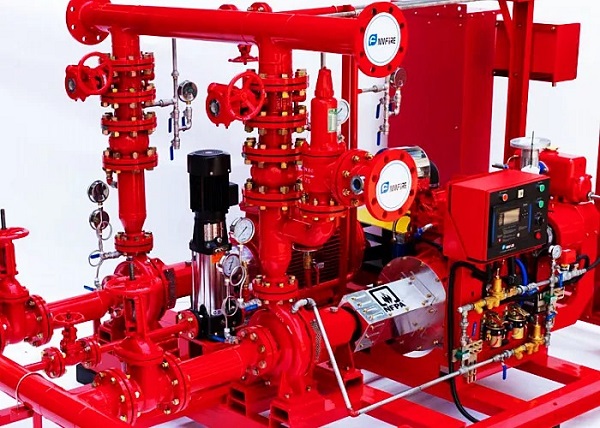
The primary objective of NFPA 20 is to ensure that fire pumps are capable of supplying an adequate and continuous flow of water at the required pressure during emergency conditions. Although the standard does not specify the hydraulic design requirements of fire protection systems, such as system capacity or pressure demand, it is closely coordinated with other NFPA standards, including NFPA 13 for sprinkler systems and NFPA 14 for standpipe systems.
Key Requirements of NFPA 20
Fire Pump Selection and Performance
Fire pumps must be selected based on the hydraulic requirements of the fire protection system.
For example, high-rise buildings typically require 500 GPM at 100 psi for the most remote standpipe outlet, plus an additional 250 GPM for each additional standpipe, up to a maximum system demand of 1,000 GPM for wet standpipe systems or 1,250 GPM for dry standpipe systems.
Fire pump performance is evaluated according to the following criteria:
Delivering 100% of the rated flow at 100% of the rated pressure.
Delivering 150% of the rated flow while maintaining at least 65% of the rated pressure.
Limiting the shutoff pressure (zero-flow condition) to no more than 140% of the rated pressure.
Common fire pump types covered by the standard include:
Horizontal centrifugal pumps.
Vertical centrifugal pumps.
Positive displacement pumps.
Installation Requirements
Suction Piping
An Outside Screw and Yoke (OS&Y) gate valve shall be installed in the suction line to isolate the fire pump when necessary.
To minimize pressure losses, the suction piping should contain only the minimum number of fittings within 50 feet (15.2 m) of the pump suction flange. Where a check valve is required to prevent reverse flow, it should be installed at least 10 pipe diameters upstream of the suction flange.
Pump Room
The pump room shall provide adequate accessibility, environmental protection, and sufficient working space for operation, inspection, and maintenance. It must also comply with applicable standards, including NFPA 72 for fire alarm systems where required.
Seismic Protection
In seismic regions, fire pumps and their supporting equipment shall be designed and installed to withstand horizontal seismic forces in accordance with NFPA 13, ASCE/SEI 7, or the applicable local building codes.
Power Supply
Testing and Maintenance
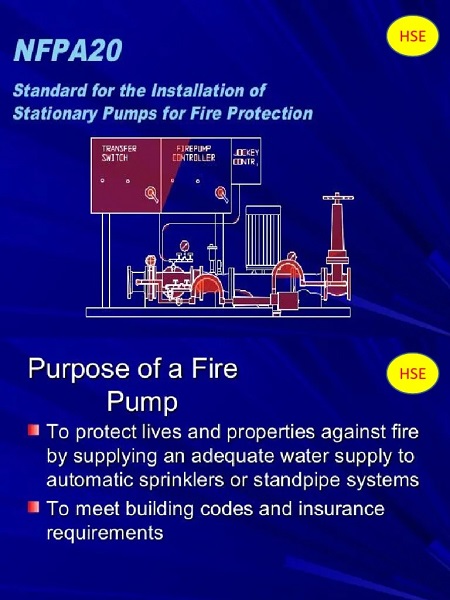
Special Considerations
High-Rise Buildings: The 2016 edition introduced specific requirements for high-rise buildings, including series pump arrangements (a maximum of three pumps, with no more than two variable-speed pumps) and a reliable emergency power supply.
Break Tanks: Break tanks used to prevent backflow or stabilize system pressure shall be sized to supply the maximum system demand for at least 15 minutes at 150% of the pump rated capacity and shall be equipped with automatic refill mechanisms.
Controllers: Fire pump controllers shall provide reliable starting and control of fire pumps, with wiring and overcurrent protection in accordance with the requirements of NFPA 20.
Applications
NFPA 20 is used in a wide range of applications, including:
- * **Commercial Buildings:** To ensure adequate water pressure for fire protection systems.
- * **High-Rise Buildings:** To overcome elevation challenges and ensure adequate water pressure for the upper floors.
- * **Industrial Facilities:** Such as factories and chemical storage warehouses.
- * **Rural Areas:** Where fire pumps are required to boost pressure from natural water sources.
Recent Updates to NFPA 20
NFPA 20 is typically updated on a three-year revision cycle. Recent editions have introduced several important changes aimed at improving reliability, safety, and system performance:
2022 Edition: Revised requirements for fuel tanks and the addition of new performance criteria for fire pump systems.
2019 Edition: Improved guidelines for high-rise buildings and the introduction of advanced starting and control systems.
2016 Edition: Added requirements for multi-stage pumps and introduced specific provisions for high-rise applications.
As noted, NFPA 20 is one of the fundamental standards in fire protection engineering. By providing comprehensive installation and performance requirements, it ensures the reliability and effectiveness of fire pump systems during emergency conditions.
Understanding this standard is essential for engineers, facility managers, and inspectors to ensure that fire protection systems operate safely and reliably when they are needed most.