
What Is NPSH?
The terms Net Positive Suction Head (NPSH), Preferred Operating Region (POR), and Allowable Operating Region (AOR) are widely used throughout the pump industry. However, many pump users do not have a clear understanding of these concepts or of their impact on pump reliability.
This article explains these important terms to help users better understand their meaning and significance. It also introduces industry resources that provide guidance on these requirements and explains why operating a pump within its Preferred Operating Region (POR) and maintaining an adequate NPSH margin are essential for achieving reliable and efficient pump performance.
Industry Standards
To address these two critical subjects—NPSH margin and pump operating regions—the Hydraulic Institute (HI) has published and recently updated two American National Standards.
These standards provide recommendations regarding the required NPSH margin for different pump designs as well as guidance on the recommended Preferred Operating Region (POR) to ensure optimum performance and long-term reliability.
Pressure Terminology and NPSH
To understand these concepts, it is first necessary to become familiar with the terms used to describe energy within a pumping system.
In the rotodynamic pump industry, energy is commonly expressed as total head, measured in feet or meters of liquid. There is a direct relationship between head and pressure.
For example, in U.S. customary units, 1 pound per square inch (psi) is equivalent to approximately 2.31 feet of water at 68°F (20°C) when the liquid has a specific gravity of 1.0. For other liquids or different water temperatures, the conversion depends on the liquid’s specific gravity.
Consider a water tank with a water depth of 23 feet. If the pressure at the water surface is 0 psi (gauge pressure), the pressure at the bottom of the tank will be approximately 10 psi (gauge).
Gauge pressure does not include atmospheric pressure.
At sea level, atmospheric pressure is approximately 14.7 psi. Therefore, the absolute pressure at the bottom of the tank is:
10 psi (gauge) + 14.7 psi (atmospheric) = 24.7 psia
This is equivalent to approximately 57 feet of absolute head.
The distinction between gauge pressure and absolute pressure is extremely important when evaluating Net Positive Suction Head (NPSH).
Net Positive Suction Head Available (NPSHa)
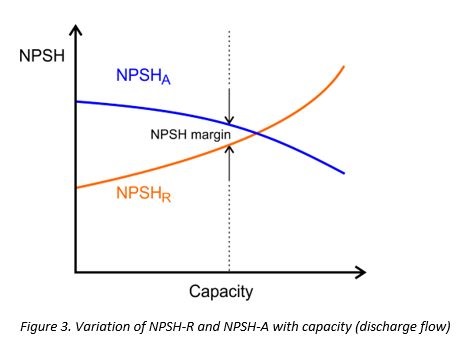
Net Positive Suction Head Available (NPSHa) is the amount of absolute suction head, expressed in feet or meters, that exceeds the vapor pressure of the liquid at its operating temperature.
If the available suction head decreases until it equals the liquid’s vapor pressure, the liquid begins to vaporize inside the pump, resulting in cavitation.
Cavitation reduces pump efficiency and can cause serious damage to the impeller and other internal components. Maintaining sufficient NPSHa is therefore essential for reliable, efficient, and long-lasting pump operation.
Operating Regions
Pump impellers are designed to operate most efficiently at a specific flow rate, where the liquid enters the impeller at the optimum vane angle. This operating condition is located near the pump’s Best Efficiency Point (BEP).
The range of operation in which both efficiency and reliability are maintained is known as the Preferred Operating Region (POR).
Outside this range lies the Allowable Operating Region (AOR). Although the pump can still operate within the AOR, doing so may reduce its service life and overall reliability.
Operating outside the POR can lead to:
Increased vibration.
Higher risk of cavitation.
Reduced hydraulic efficiency.
Increased mechanical wear.
For optimum performance and long-term reliability, pumps should be operated as close to the BEP and within the POR whenever possible.
NPSH Margin
Net Positive Suction Head Required (NPSHr) is the minimum suction head required for a pump to operate without experiencing a measurable loss of head due to cavitation. This value is determined by the pump manufacturer and is typically provided in the pump performance curve or technical documentation.
In practice, however, it is recommended to provide an NPSH margin above the published NPSHr, particularly for high-energy and high-speed pumps.
When a pump operates away from its Best Efficiency Point (BEP) and outside the Preferred Operating Region (POR), a larger NPSH margin is generally required to minimize the risk of cavitation and maintain reliable operation.
For this reason, compliance with the recommendations of ANSI/HI 9.6.1 and ANSI/HI 9.6.3 is strongly recommended to ensure safe, efficient, and dependable pump performance throughout its operating life.