
History of Water Transportation
History of Water Transportation
Why Did Humans Need to Transport Water?
Agriculture
Early humans realized that by transporting water to their fields, they could significantly increase food production. Irrigation became one of the foundations of agricultural development and the growth of civilizations.
Permanent Settlements
As humans transitioned from a nomadic lifestyle to permanent settlements around 10,000 years ago, they required reliable and accessible sources of fresh water to support daily life.
Population Growth
As cities expanded, nearby water sources could no longer meet growing demands. This led to the development of engineered systems capable of transporting water over greater distances.
Public Health and Sanitation
With larger populations living together, access to clean water became essential for preventing disease. At the same time, wastewater needed to be safely removed from residential areas, encouraging the development of advanced water supply and drainage systems.
Who Were the First Water Transport Engineers?
Water transportation refers to the practice of conveying water from one location to another using engineered systems such as canals, pipelines, waterwheels, qanats, and aqueducts, rather than collecting it directly from rivers or springs.
The earliest civilizations to independently develop water transportation systems include:
Sumerians (c. 3000 BC)
Region: Mesopotamia (modern-day Iraq)
The Sumerians built earthen canals and primitive dams to irrigate farmland.
Major Innovation: Irrigation engineering and organized water distribution.
Ancient Egyptians (c. 2500 BC)
Region: Nile Valley
The Egyptians constructed surface canals connected to the Nile River.
Major Innovation: Irrigation systems synchronized with the annual flooding of the Nile.
Indus Valley Civilization (c. 2500 BC)
Region: Present-day Pakistan and India
This civilization developed surface canals along with highly advanced urban drainage systems.
Major Innovation: Sophisticated wastewater and stormwater management.
Ancient Chinese (c. 2000 BC)
Region: Yellow River Basin
The Chinese built dams, canals, and dikes to manage water resources.
Major Innovation: Flood control and river engineering.
Persians – Qanat System (c. 1000–800 BC)
Region: Persia, later spreading across the Middle East and North Africa
The Persians developed underground qanat systems that transported groundwater without pumps.
Major Innovation: Gravity-fed underground water transportation.
Ancient Greeks (c. 700 BC)
Region: Greece
The Greeks used clay pipelines and reservoirs to distribute water.
Major Innovation: Combining architectural design with hydraulic engineering.
Romans (from 312 BC onward)
Region: Italy, Europe, and the Middle East
The Romans constructed large aqueduct systems to supply water to cities.
Major Innovation: Large-scale urban water supply networks.
Which Civilization Was the First?
Historical and archaeological evidence generally recognizes the Sumerians, around 3000 BC, as the first civilization to engineer large-scale water transportation systems.
Living in the dry plains between the Tigris and Euphrates rivers, they constructed extensive networks of canals, reservoirs, and primitive dams for irrigation. Clay tablets discovered from the Sumerian civilization reveal evidence of organized water management, hydraulic engineering, and even regulated water allocation systems for agricultural land.
Civilizations with Outstanding Innovations
Persians and the Qanat System
The Persian qanat is considered one of the greatest innovations in underground water transportation.
By excavating gently sloping tunnels connected by vertical access shafts, groundwater could flow continuously from aquifers to the surface without pumps or external energy. Over time, this technology spread from Persia to Arabia, North Africa, Al-Andalus (Spain), and eventually parts of Latin America during the Middle Ages.
Romans and the Aqueduct
The Romans developed one of the largest water transportation systems in history through the construction of aqueducts.
Aqueduct construction began around the 4th century BC, and some, such as the Aqua Marcia, stretched nearly 90 kilometers (56 miles). Roman engineers used waterproof concrete, carefully designed arches, and large distribution reservoirs to deliver fresh water efficiently to cities.
What Is a Qanat?
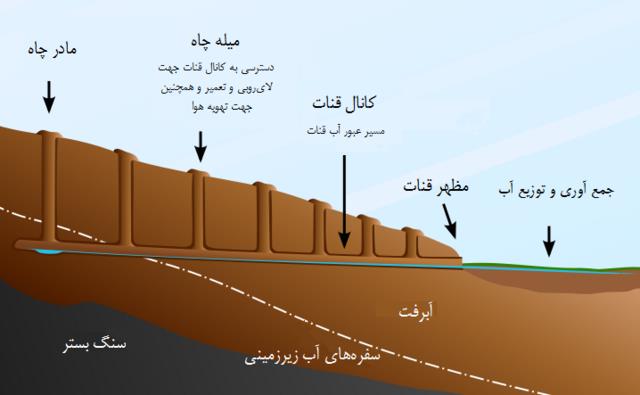
A qanat is an underground water conveyance system that transports groundwater from elevated aquifers to lower, arid regions through a gently sloping tunnel, entirely by gravity and without the need for pumps.
Components of a Qanat
Mother Well: A deep vertical shaft reaching the groundwater aquifer.
Access Shafts: Vertical shafts built along the tunnel for ventilation, maintenance, and excavation.
Underground Tunnel: A gently sloping passage that carries water toward lower elevations.
Outlet (Mazhar): The location where water emerges at the ground surface.
Advantages of a Qanat
Minimizes water loss through evaporation, making it ideal for hot and arid climates.
Operates entirely by gravity without pumps or external energy.
Offers an exceptionally long service life, with some qanats functioning for more than 2,500 years.
Provides a sustainable water supply for permanent settlements in desert regions.
Limitations of a Qanat
Construction is labor-intensive and time-consuming.
Without regular maintenance, tunnels may collapse or become blocked.
Can only be built in areas with suitable natural slopes and geological conditions.
A Famous Example
The Qasabeh Qanat of Gonabad in Iran is over 2,500 years old and is recognized as a UNESCO World Heritage Site. It remains one of the oldest and most impressive examples of sustainable hydraulic engineering in the world.
Roman Aqueduct Technology
What Is an Aqueduct?
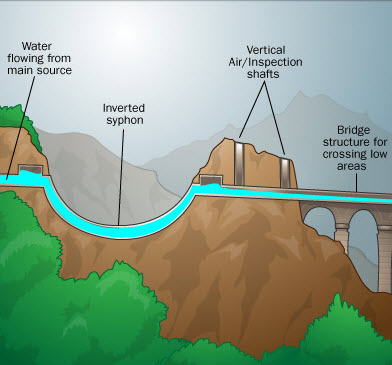
An aqueduct is an above-ground water transportation system designed to carry water from distant springs, rivers, or reservoirs to cities. It typically consists of stone or brick channels supported by a series of arches, allowing water to flow over long distances using gravity.
Main Components of an Aqueduct
Reservoir: The source or storage basin where the water supply begins.
Water Channel: A gently sloping channel engineered to maintain a continuous gravity-driven flow.
Stone Arcades: Large stone arches that enable the aqueduct to cross valleys, rivers, and uneven terrain.
Distribution System: Including settling tanks, filters, intermediate reservoirs, and control valves to regulate water flow and improve water quality.
Advantages
High capacity for supplying water to cities, public baths, fountains, and other urban facilities.
Ability to cross valleys and other natural obstacles with engineered arches.
Easy access for inspection, maintenance, and repairs.
Limitations
Very high construction costs.
Vulnerable to earthquakes and military attacks.
Greater water loss through evaporation in hot climates because the channels are exposed above ground.
Famous Examples
Pont du Gard in southern France is one of the best-preserved Roman aqueducts and remains standing today as a masterpiece of Roman engineering.
Aqua Claudia, built in ancient Rome, was one of the city’s most important aqueducts and supplied large volumes of fresh water to the Roman population.
Water Transportation During the Middle Ages (5th–15th Century AD)
Qanats
Regions: Persia, parts of North Africa, the Arabian Peninsula, and Al-Andalus (Islamic Spain)
During the Abbasid and Fatimid Caliphates, Muslim engineers further developed qanat construction techniques. In Al-Andalus, qanats were integrated into urban water supply systems, particularly in cities such as Cordoba and Granada, providing reliable water for both domestic use and agriculture.
Aqueducts
Regions: Europe, especially areas influenced by the Roman Empire, including Spain, France, Italy, and Macedonia
Following the fall of the Roman Empire, many aqueducts were abandoned. However, important systems in cities such as Rome, Paris, Oxford, and Constantinople continued to be maintained and repaired. During the Islamic rule of Spain, new aqueducts were also constructed, while existing Roman structures were restored and improved.
Water Wheels (Norias)
Regions: Syria, Iraq, Persia, Spain, and parts of Europe
Large water wheels installed along rivers lifted water using buckets or containers attached to the wheel, delivering it to elevated canals or reservoirs.
Muslim engineers significantly improved these devices, with the Norias of Hama in Syria becoming one of the most famous examples. In Europe, water wheels were widely used for irrigation, operating mills, and supplying water to towns and cities.
Open Irrigation Canals
Regions: Islamic countries, India, China, and the Byzantine Empire
Open canals and irrigation channels transported water from rivers and springs to farms, orchards, and gardens. Water flow was regulated using embankments, gates, and small dams.
In India, large storage tanks and reservoirs were constructed to store water, while in China, extensive canal systems were developed for irrigation and water transportation alongside roads and settlements.
Early Human- and Animal-Powered Pumps (Shadoof and Sakia)
Regions: Egypt, the Middle East, and India
The Shadoof was a hand-operated lever equipped with a bucket that lifted water from rivers and canals using human power.
The Sakia consisted of a rotating wheel fitted with buckets and powered by animals such as oxen, buffaloes, or donkeys.
During the Middle Ages, these technologies were further refined throughout the Islamic world before eventually spreading to Europe.
Rainwater Harvesting
Regions: Arid areas of the Middle East, North Africa, and Southern Europe
Rainwater was collected and stored in ponds, reservoirs, and cisterns to provide a dependable water supply throughout the year.
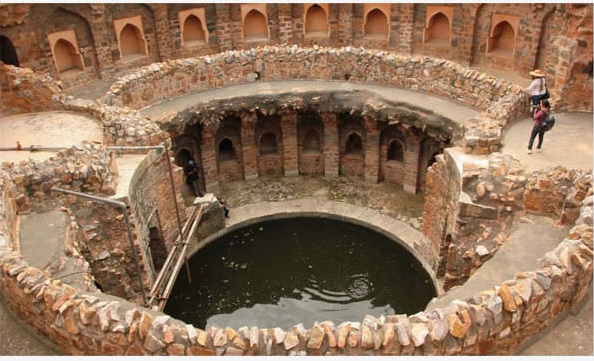
Historic examples include the traditional underground water reservoirs of Kashan and Yazd in Iran, as well as the famous Basilica Cistern in Constantinople.
Urban Pipelines and Public Fountains
Regions: Islamic cities and medieval Europe
Urban water distribution networks used clay or lead pipes to transport water to public fountains, baths, and communal reservoirs.
Cities such as Baghdad, Damascus, and Cairo developed highly organized municipal water management systems. Likewise, European cities including Florence and London relied on public fountains as essential sources of drinking water.
Summary
Throughout the Middle Ages, water transportation remained largely based on the engineering knowledge inherited from ancient civilizations while making extensive use of natural forces, human labor, and animal power. Many of the most significant innovations during this period originated in the Islamic world and were later transmitted to Europe. These developments laid the technological foundation for many of today’s modern urban water supply systems.
Water Transportation Methods from the Renaissance to the Industrial Revolution (15th–18th Century)
Water Wheels
Large water wheels were powered by the flow of rivers or streams. Through a system of gears and pulleys, the rotational energy generated by the wheel was transferred to mechanical pumps that lifted water to higher elevations.
Applications: Pumping water from rivers for irrigation, supplying water to low elevations, and powering mills, early industries, and agricultural operations.
Advantages:
Operated entirely on the energy of flowing water without the need for fuel.
Simpler maintenance compared to later mechanical technologies.
Limitations:
Could only be installed near rivers or permanent watercourses.
Performance depended heavily on the strength and consistency of the water flow.
Hand-Operated and Foot-Operated Pumps
Simple mechanical pumps powered by human or animal labor became widely used during this period. These included piston and rotary pumps designed to lift water from wells, rivers, or reservoirs.
Common examples included:
Hand Pumps, operated manually.
Foot Pumps, powered by foot pedals.
Animal-Powered Pumps, driven by oxen, horses, or donkeys using rotating mechanisms.
Advantages:
Low construction and operating costs.
Suitable for use in a wide range of locations.
Limitations:
Limited flow rate and pumping height.
Required continuous human or animal effort.
The Archimedean Screw
The Archimedean Screw consists of a helical screw enclosed within a tube. As the shaft rotates, water is lifted from a lower level to a higher elevation.
Although the device had been invented in antiquity, its use expanded significantly during the Renaissance.
Applications: Agricultural irrigation, water transfer, and filling small reservoirs.
Advantages:
Simple and reliable design.
Well suited for areas with low elevation differences.
Limitations:
Effective only for relatively short pumping distances and low lifting heights.
Artificial Canals and Surface Irrigation Systems
Engineers constructed artificial canals to divert water from rivers to farmland and settlements. Small dams and diversion structures were often incorporated to regulate water flow.
Italian, Spanish, and Dutch engineers developed increasingly advanced canal systems, building upon hydraulic engineering knowledge inherited from Roman and Islamic civilizations.
Early Wooden and Metal Pipeline Systems
Beginning in the 16th century, several European cities introduced water distribution systems using hollowed wooden logs and lead pipes.
In England and other parts of Europe, these pipelines transported water from wells and reservoirs to homes, public fountains, and urban centers.
Advantages:
Reduced the need to transport water manually using buckets or containers.
Represented an early step toward modern municipal water distribution systems.
Limitations:
Wooden pipes had relatively short service lives.
Lead pipes posed significant health risks due to lead contamination.
Early Steam-Powered Pumps
During the late 17th century and early 18th century, inventors such as Thomas Savery and Thomas Newcomen developed the first practical steam-powered pumps to remove water from mines.
These machines marked the beginning of the Industrial Revolution and represented the first major application of steam power in water transportation.
Advantages:
Capable of lifting water from much greater depths, particularly in mining operations.
Established the foundation for engine-powered water pumping systems.
Transition to the Industrial Revolution
From around 1760 onward, major improvements in steam engine technology—particularly those introduced by James Watt—transformed water transportation systems.
More powerful and efficient pumping equipment enabled cities to transport water over much longer distances and to much higher elevations, no longer relying solely on favorable geography or natural water flow. These innovations laid the foundation for the modern water supply infrastructure used throughout the world today.
Water Transportation Methods in the 19th Century
The 19th century marked one of the most significant turning points in the history of water engineering. During this period, modern technologies gradually replaced traditional methods such as qanats and aqueducts. Coinciding with the peak of the Industrial Revolution in Europe and North America, rapid industrialization, urbanization, improvements in public health, and expanding agriculture dramatically increased the demand for reliable water supplies. Traditional systems were no longer capable of meeting these growing needs.
Urban Pipeline Networks
Cities began constructing extensive distribution systems using cast-iron and later steel pipelines to transport water from rivers, springs, and reservoirs to storage tanks and eventually to homes and public buildings.
Advantages:
Safe and reliable water transportation.
Reduced risk of contamination.
Easier maintenance and repair.
Leading Countries: England (London), France (Paris), and the United States (New York).
A notable example is London’s modern water supply system, designed by Sir Joseph Bazalgette following the cholera epidemics of the 1850s.
Mechanical Pumps (Steam and Later Electric)
Steam engines were widely used to pump water from rivers and wells to elevated reservoirs and urban distribution networks.
The first generation of these systems was powered by the James Watt steam engine.
Applications:
Pumping water from rivers and wells.
Supplying elevated reservoirs for cities and industrial centers.
Industrial cities such as Manchester and Chicago relied heavily on these pumping systems.
Elevated Water Tanks and Water Towers
Tall water towers were constructed to store water at high elevations. Water was pumped to the top of the tower and then distributed throughout the city using gravity.
Advantages:
Stable water pressure.
Reliable water storage.
Continuous distribution during periods of peak demand.
Many of these structures remain important architectural landmarks in Europe and North America.
Dams and Artificial Canals
Small earth and masonry dams were built to store water and divert it through canals for agriculture and municipal supply.
Although relatively simple by modern standards, these systems were far more organized and efficient than those used during the Middle Ages.
Countries such as France, Germany, and the United States invested heavily in these projects.
Water Filtration and Treatment
During the mid-19th century, outbreaks of diseases such as cholera highlighted the importance of clean drinking water.
New treatment technologies included:
Slow sand filtration
Chlorination (introduced in the late 19th century and widely adopted in the early 20th century)
These innovations dramatically improved public health and reduced waterborne diseases.
Summary
The 19th century marked the beginning of modern water supply systems. For the first time, water was pumped, stored, treated, and distributed through extensive pipeline networks, establishing the foundation of today’s municipal water infrastructure.
Water Transportation from the 19th Century to the Present
Steam-Powered Pumps and Municipal Waterworks (Early to Mid-19th Century)
Large-scale steam-powered pumping stations enabled cities to transport vast quantities of water from distant rivers and reservoirs.
Operating Principle
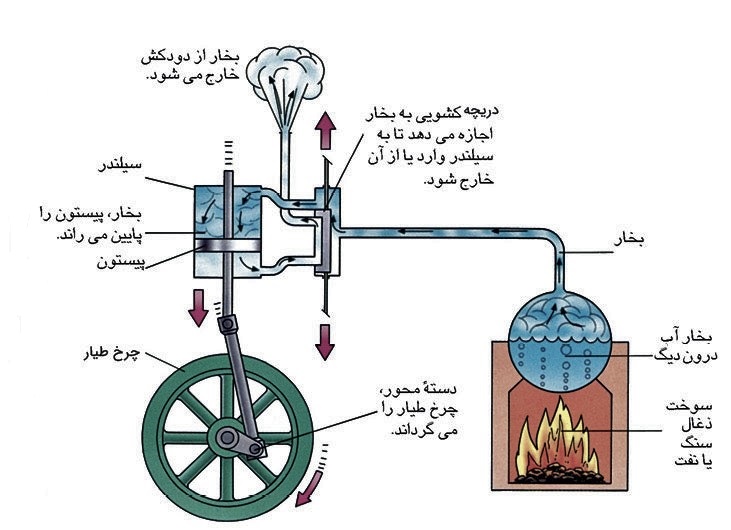
Steam engines generated rotational motion, which was converted into reciprocating or centrifugal pump movement. Water was drawn from the source and pumped into storage reservoirs or transmission pipelines.
Advantages:
Independent of human and animal labor.
Much higher pumping capacity than manual systems.
More stable pressure for early municipal networks.
Limitations:
High fuel consumption (coal and wood).
Required skilled operators and extensive maintenance.
Produced significant air pollution.
Victorian pumping stations in London are among the best-known examples.
Cast-Iron Pipelines, Pressurized Networks, and Water Towers
The widespread adoption of cast-iron pipes during the 19th century enabled the construction of modern pressurized distribution systems.
Water was pumped into reservoirs and elevated water towers before flowing to consumers by gravity.
Advantages:
Uniform water distribution.
Adequate pressure for firefighting.
Eliminated the need for manual water transport.
Limitations:
High installation costs.
Risk of leaks and pipe failures.
Early systems occasionally suffered from contamination problems.
Sand Filtration and Chlorination (Late 19th–Early 20th Century)
As scientists established the link between contaminated water and infectious diseases, cities increasingly invested in water treatment.
Operating Principle
Slow Sand Filtration: Water passes through layers of sand, removing suspended particles and many microorganisms.
Chlorination: Carefully controlled doses of chlorine disinfect the water by destroying harmful pathogens.
Impact:
These technologies became the cornerstone of safe urban drinking water systems and supported rapid urban growth.
Electrification and Electric Pumps (Early to Mid-20th Century)
The widespread availability of electricity allowed electric pumps to replace steam engines.
Technical Advantages:
Higher efficiency.
Faster startup.
Lower maintenance requirements.
Suitable for both small and large installations.
Compatible with automated control systems and Variable Frequency Drives (VFDs) for energy optimization.
Large Dams, Reservoirs, and Inter-Basin Water Transfer (Mid-20th Century to Present)
Growing agricultural and urban demands led to the construction of massive dams, reservoirs, tunnels, canals, and long-distance pipeline systems capable of transporting water over hundreds of kilometers.
Common infrastructure includes:
Open canals.
Water transfer tunnels.
High-pressure transmission pipelines.
Large pumping stations.
Reservoir-pump complexes.
Major examples include China’s South-to-North Water Transfer Project, the California Aqueduct in the United States, and numerous inter-basin transfer projects around the world.
Advantages:
Supports major cities and large-scale agriculture.
Limitations:
Extremely high construction costs.
Significant environmental impacts.
Displacement of communities.
Dependence on seasonal water availability.
Evolution of Pipeline Materials (20th Century)
Pipeline technology evolved considerably throughout the 20th century.
After cast iron, engineers introduced:
Reinforced concrete pipes.
Asbestos-cement pipes.
Steel pipelines.
PVC pipes.
HDPE (High-Density Polyethylene) pipes.
Advantages:
Faster installation.
Lower maintenance costs.
Greater corrosion resistance.
Improved flexibility for long-distance networks.
Desalination Technology (20th Century)
Modern desalination evolved from thermal processes such as Multi-Stage Flash (MSF) and Multi-Effect Distillation (MED).
Research into Reverse Osmosis (RO) during the late 1950s led to successful commercial applications throughout the 1960s and 1970s, making RO the dominant desalination technology worldwide.
Wastewater Treatment and Water Reuse
Modern biological wastewater treatment began developing in the early 20th century with the Activated Sludge Process (1913).
By the late 20th century, reclaimed water became widely used for irrigation, industrial processes, and, following advanced purification, even indirect potable water reuse.
Operating Process
Biological aeration → Sedimentation → Advanced treatment (filtration, UV disinfection, or chlorination) → Water reuse or aquifer recharge.
Advantages:
Reduces pressure on freshwater resources.
Improves long-term water security.
Limitations:
Requires skilled operation.
High energy consumption.
Sludge management challenges.
Digitalization, Automation, and Smart Water Systems (Late 20th Century to Present)
Remote monitoring began during the mid-20th century, while SCADA (Supervisory Control and Data Acquisition) systems became widespread during the 1970s.
Today, sensors, PLCs, IoT devices, hydraulic models, and smart water networks continuously monitor pressure, flow rate, water quality, and leakage in real time.
Key technologies include:
Advanced Metering Infrastructure (AMI)
SCADA systems
Smart leak detection
Real-time hydraulic modeling
Benefits:
Reduced non-revenue water losses.
Improved energy efficiency.
Faster response to failures.
Better maintenance planning.
Sustainable Water Technologies (21st Century)
Modern innovations include:
Advanced water reuse systems for municipal, industrial, and agricultural applications.
Advanced membrane technologies, including nanofiltration, ultrafiltration, and high-efficiency reverse osmosis membranes.
Renewable-energy-powered pumping and desalination systems using solar and hybrid energy sources.
Managed Aquifer Recharge (MAR), where water is intentionally infiltrated or injected into aquifers for long-term underground storage and future recovery.
Emergency Water Transportation
Temporary water supply methods include:
Water tankers and tanker trucks.
Portable pipeline systems.
Water transport by ships, barges, or tankers to islands and remote regions.
Although these solutions are expensive and temporary, they are essential during emergencies and natural disasters.
Challenges and Future Considerations
Energy Consumption
Modern technologies such as long-distance pumping and reverse osmosis desalination require substantial amounts of energy. Improving efficiency and recovering energy remain major engineering priorities.
Environmental Impact
Large dams, inter-basin transfer projects, and desalination plants can significantly affect ecosystems, biodiversity, and local communities.
Water Governance
Long-distance water transfer projects may create political and social conflicts over water allocation, making sustainable management and equitable distribution increasingly important.